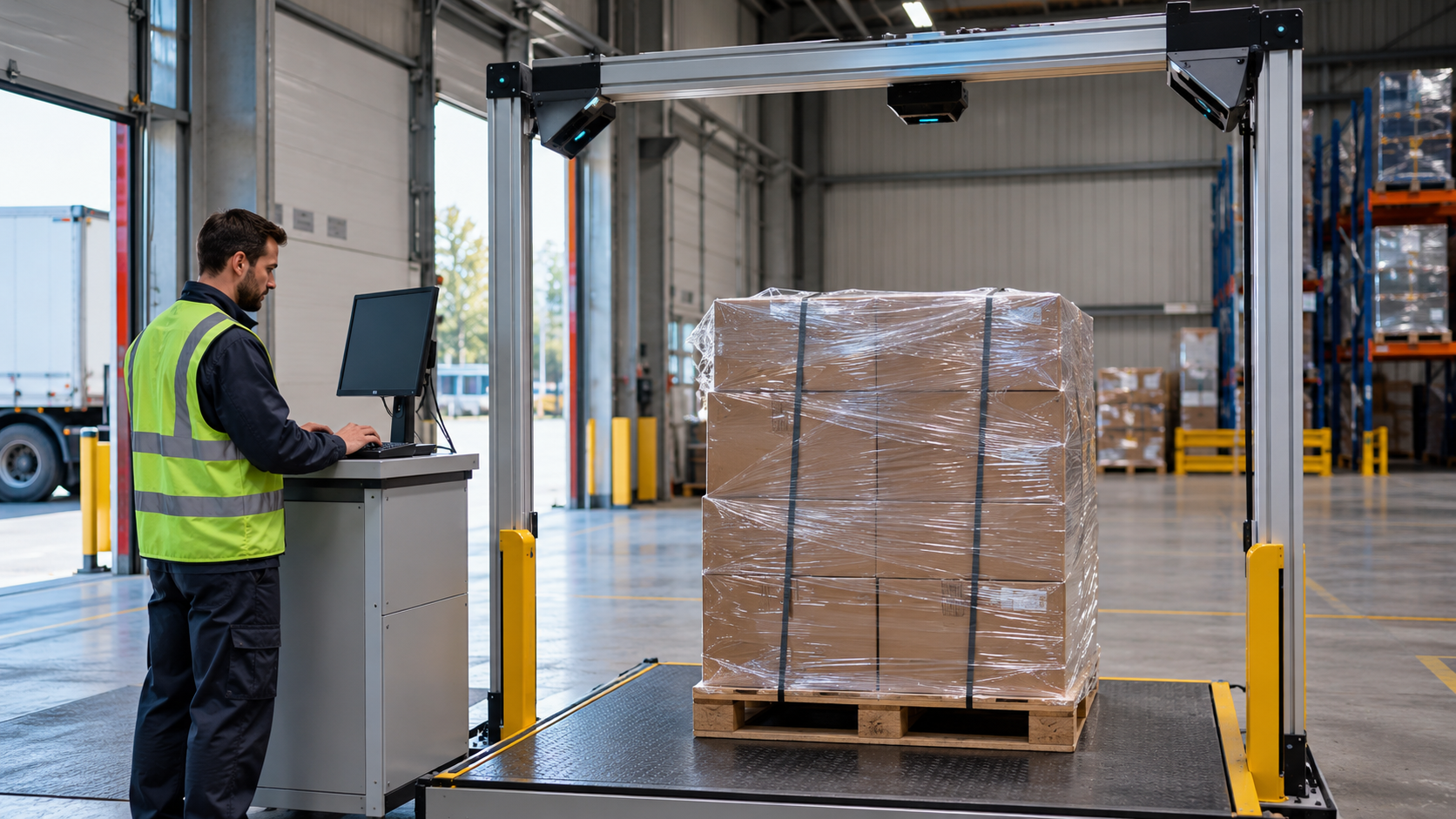
A freight dimensioner captures the physical dimensions of a shipment using measurement technology suited to its intended operating conditions. In a warehouse or freight terminal, it can help record pallet length, width and height consistently and connect those measurements to a shipment record. Some setups combine dimensioning with weighing and images, but those capabilities must be verified for the actual system.
Better measurements can improve quote accuracy, load planning and invoice investigation. They do not automatically guarantee a lower rate or eliminate every carrier adjustment. The result depends on the measurement method, data quality, shipment identity and the pricing rules applied to that freight.
Measure the finished handling unit
Dimensions should describe the shipment as it will be handed to the carrier. Include the pallet, protective packaging and protruding parts. Measuring the product before it is placed in a crate can produce a number that is technically correct for the product but wrong for the freight booking.
Record restrictions such as non-stackability separately. A rectangular volume does not tell the carrier whether another pallet can be placed above the load or whether an irregular item needs special handling. Good shipment data combines measurements with an accurate description and operational requirements.
Understand what the equipment can and cannot capture
Ask the supplier which load sizes, shapes and surfaces the system supports. Test irregular freight, dark or reflective wrapping, protrusions and the packaging types your operation actually uses. A demonstration with one perfectly square pallet does not establish performance across your product range.
Confirm the required positioning, clearance, movement speed and environmental conditions. A system that works well at a dedicated station may not fit a constrained loading area. Also clarify whether weight comes from an integrated scale or a separate source, and how the two records are associated.
Connect the measurement to the right shipment
The most accurate dimensions are useless if assigned to the wrong pallet. Define the identifier captured at the station and how it links to the booking. Handle multi-pallet shipments explicitly: the record should preserve each handling unit rather than silently copying one pallet’s dimensions to all units.
If a pallet is repacked after measurement, the process needs a trigger to measure it again. Retain the timestamp and relevant evidence so users know which configuration the data represents. Avoid overwriting history in a way that makes a later discrepancy impossible to investigate.
Use the data in quotes and audits
Reliable dimensions support LTL shipment preparation, but classification and pricing may also depend on other factors. In US freight, an FAK agreement does not remove the need for accurate commodity and shipment information. Do not infer a freight class from a dimensioner reading alone without applying the relevant classification requirements.
For a carrier measurement discrepancy, compare the shipment identifiers, measurement times, packing configuration and methods. The aim is to understand the difference, not automatically declare one device correct. Supporting images and records can strengthen a freight invoice review, subject to the applicable terms and evidence requirements.
Build a realistic acceptance test
- Common pallet types and the largest and smallest supported loads.
- Irregular profiles, overhang and representative wrapping materials.
- Multi-pallet shipments with distinct identifiers.
- Repacked freight requiring updated measurements.
- Missing or unreadable labels and operator correction workflows.
- Connection failures and safe recovery without duplicate records.
- Comparison with an appropriate reference measurement procedure.
Agree acceptance criteria with the supplier before purchase. Consider repeatability, usable throughput, error handling and the effort needed from operators. Where measurements are used for regulated commercial purposes, confirm the applicable certification and verification requirements with the appropriate specialists rather than assuming any device is suitable.
Calculate payback without invented savings
Estimate the current time spent measuring, entering data and investigating measurement-related disputes. Separate avoidable work from checks that will remain necessary. Include hardware, installation, integration, maintenance, training and space in the investment model.
For a fictional calculation, suppose a system and implementation cost $30,000 and verified net annual savings are $10,000 after operating costs. Simple payback is three years, before financing and other effects. If the assumed savings are not supported by a pilot, the calculation is a hypothesis—not an ROI claim. Do not count every carrier adjustment as recoverable revenue.
Keep the process reliable after installation
Assign responsibility for inspection, maintenance, verification and data-quality monitoring. Train users on exceptions as well as normal operation. Review how often measurements fail, are manually changed or fail to reach the booking system.
A freight dimensioner is most useful as part of a controlled shipping workflow. Accurate capture, correct identity and a clear remeasurement rule matter more than a device specification in isolation. Test the actual freight, preserve evidence and judge the investment by the complete improvement in shipment preparation.
Define how manual corrections are approved
Operators need a controlled way to handle an unreadable identifier or an unsupported load. Record why a measurement was overridden, who made the correction and which evidence supports the replacement value. A silent manual edit can remove the very traceability the system was purchased to improve.
Separate measurement failure from integration failure. If the device captured a valid result but the booking system did not receive it, measuring the pallet repeatedly may create more confusion. The user should see the appropriate recovery step and know when to contact technical support or a supervisor.
Evaluate throughput across the whole station
Include positioning, identification, measurement, exception handling and removal in the cycle time. A sensor’s advertised capture speed does not equal the number of usable shipment records your operation can produce in an hour. Observe queues and the effect on adjacent loading activities during the pilot.
Test the arrangement with different operators and representative freight. A process that depends on one experienced person recognizing every unusual case may need clearer instructions before expansion. After launch, monitor the share of successful first-pass measurements and the reasons for rework. Use that information to improve labels, layout or training before assuming another device is required. The investment should make the shipping record more reliable and the work easier to control, with a practical exception path when the technology cannot confidently handle a load.