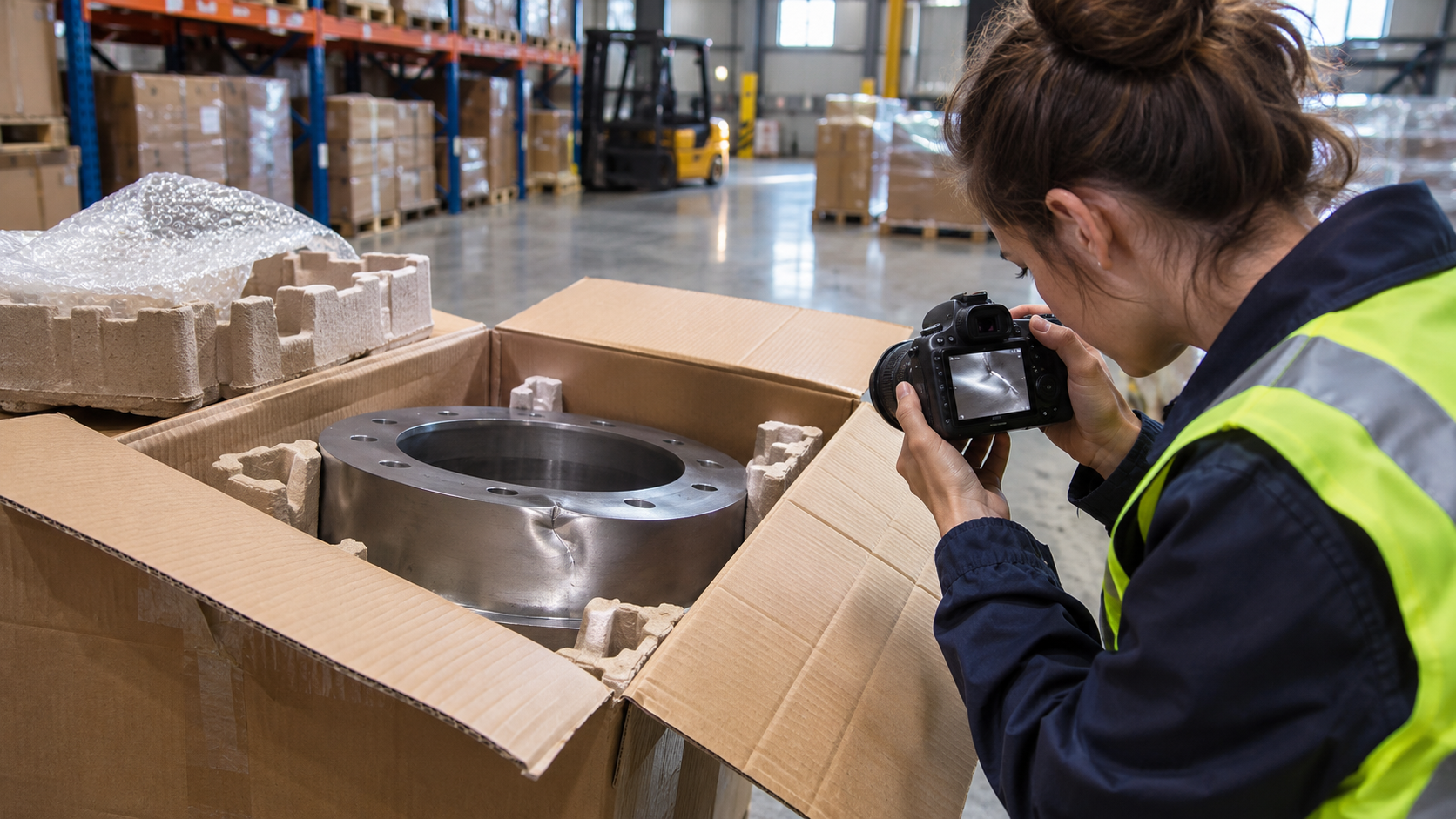
Concealed freight damage is damage discovered after delivery that was not apparent during the initial external inspection. An intact carton can hide a bent component, cracked fitting or internal movement. Finding the problem later makes the evidence trail especially important because the carrier, supplier and receiver may disagree about when and how the damage occurred.
Act promptly, preserve the shipment and document what you actually know. A signed delivery receipt without an exception can make the investigation harder, but it should not be treated as a reason to abandon the process without checking the applicable terms. This guide describes practical evidence handling; claim rights and deadlines depend on the shipment and governing agreement.
Stop further handling and preserve the condition
Separate affected goods from usable inventory and prevent further damage where safe to do so. Keep the outer packaging, internal cushioning, pallet, labels and any indicators attached to the shipment. Do not discard them simply because the product appears repairable or a replacement is urgently needed.
Avoid repairs, destructive testing or disposal until the relevant parties have had an opportunity to provide instructions. If an urgent action is necessary to prevent additional loss, document the reason and what was done. Safety takes priority: do not handle a leaking, unstable or otherwise hazardous item just to obtain a better photograph.
Photograph a sequence, not one close-up
Start with the overall shipment and its identifying labels. Capture each side of the packaging, the opening process where still possible, protective materials and the item’s position inside. Then photograph the damage with enough context to understand its location and scale.
Preserve original files and timestamps. Record who discovered the issue, when it was found and where the goods had been stored since delivery. A close-up of a dent alone rarely explains whether packaging was adequate, whether the correct shipment is shown or whether the item was moved after receipt.
Notify the right parties promptly
Contact the carrier or the agreed claims channel and inform the shipper, supplier or broker as appropriate. Include shipment reference, delivery date, discovery date, a factual description and initial photographs. Ask whether an inspection is required and how the goods should be retained.
Check the applicable bill of lading, contract and tariff immediately. Do not rely on an assumed universal concealed-damage reporting period. Operational notice requirements and the deadline for a formal claim are not necessarily the same. If the goods are insured, notify the insurer under the relevant policy conditions as well.
A damage notation is not necessarily a formal claim
For covered US freight claims, 49 CFR 370.3 describes minimum written claim elements, including identification of the shipment, an assertion of liability and a specified or determinable monetary amount. An inspection report or a damage notation alone is not sufficient under that provision.
Use the current applicable requirements and the carrier’s submission procedure for your shipment. Keep proof of submission and a claim reference. A message asking someone to look at photographs may start an investigation without completing the formal claim process. Ask for clarification when the status is unclear.
Build a claim file that can be followed
Include the booking, bill of lading, delivery receipt, commercial invoice and relevant packing information. Add photographs before dispatch if available, receiving records, inspection results and a chronology of later handling. Support the amount claimed with a repair estimate, replacement evidence or another appropriate valuation basis.
Distinguish product value from additional costs and explain each requested amount. Do not assume every consequential expense is recoverable. Carrier liability, declared value and cargo insurance are different concepts; coverage and limits must be assessed against the actual agreement and policy.
Example: a damaged machine panel
A receiver signs for an apparently intact crate and opens it the next morning. A machine panel is bent, while the outer crate has no obvious puncture. The receiving team photographs the crate, blocking, item position and damaged panel, retains everything and records where the crate was kept overnight.
The supplier supplies dispatch photographs and packing details. The carrier is notified through the agreed channel and asked about inspection. A repair estimate supports the amount being considered. None of these steps proves liability by itself, but together they create a much stronger basis for investigation than a replacement request with one cropped photograph.
Receiving-team checklist
- Record delivery and discovery times, shipment reference and affected quantity.
- Isolate the goods and preserve packaging and labels.
- Photograph the full shipment, internal protection and specific damage.
- Notify the correct parties and request inspection instructions.
- Check notice and formal claim requirements separately.
- Support the amount claimed and retain proof of submission.
- Track acknowledgment, requests for evidence and the final outcome.
Prevent the same evidence gap next time
Create an unpacking and inspection process matched to product risk. Sensitive equipment may need faster controlled inspection than robust stock. Define who checks goods when they arrive outside normal receiving hours. For specialized placement or unpacking, align these tasks with the white glove delivery scope.
Finally, review packaging performance and handling records rather than assuming every concealed problem has the same cause. Connect the lessons to your supplier routing guide. Better preparation and better evidence improve both prevention and the quality of any future claim investigation.
Keep a factual timeline from receipt to discovery
Record when the shipment arrived, who received it, when the package was opened and when the damage was first observed. Include any storage or internal movement between those events. This timeline helps the parties investigate where and how the problem may have occurred without presenting an unsupported conclusion as a fact.
Keep original photographs and documents with the shipment reference. Use overview images to identify the package and closer images to show the damage. If a component has a serial number, connect it to the record. Avoid altering the goods beyond what is necessary for safety and the agreed inspection process before the responsible parties have provided instructions.
Separate the customer recovery plan from the claim
A customer may need a replacement quickly even while responsibility for the damage remains under review. Track these as related but distinct workflows. Document any replacement shipment, repair estimate or authorized disposal so the financial record remains complete and does not double-count a loss.
Ask the appropriate party how inspection, salvage and supporting documents should be handled under the applicable terms. Do not promise a particular reimbursement before the claim has been evaluated. After the case closes, review whether packaging, receiving practice or handling instructions need to change. The evidence should support both a fair claim decision and a practical reduction in similar incidents, rather than becoming a file that is never used again.